Strong gradients, cool performance: A 64-channel array coil with concurrent field monitoring and thermal control for ex vivo diffusion-weighted brain imaging using the 3T connectome 2.0 MRI scanner

Purpose

High-resolution ex vivo diffusion-weighted imaging (dMRI) with high 𝑏-values presents significant challenges, including low signal-to-noise ratio (SNR), magnetic field perturbations, and temperature-related measurement shifts. This work introduces a hardware-based solution to address these limitations in human ex vivo brain imaging.

Methods

A customized anatomically conformal 64-channel receive array coil with a dedicated Tx birdcage coil was developed for 3T diffusion-weighted imaging of whole human ex vivo brain specimens. Field monitoring capabilities were integrated to correct spatiotemporal field perturbations caused by gradient-induced eddy currents. Temperature stability throughout extended acquisition periods was achieved through an integrated stabilization system. Coil performance was validated through comprehensive measurement of SNR, g-factor maps, field camera free induction decays (FIDs), temperature, mean diffusivity, and fractional anisotropy across multiple diffusion-weighted scans.

Results

The system demonstrated 73% higher SNR compared with a 72-channel in vivo head coil. Integration of the field camera maintained its FID quality without SNR penalties or significant receive coil coupling effects. Temperature stabilization improved the reliability of quantitative diffusion-weighted measurements by eliminating measurement drift during a 13-hour acquisition, where mean diffusivity and mean kurtosis would have increased by 22% and decreased by 19%, respectively.

Conclusion

We describe an integrated hardware approach for addressing higher order field perturbations, thermal instability, and SNR challenges in human ex vivo whole brain dMRI under high-diffusion sensitizing gradient conditions. This approach combines an anatomically optimized multichannel receive array, concurrent field monitoring, and active temperature stabilization. Enhanced image quality and improved reliability of quantitative MR imaging were demonstrated with this comprehensive hardware solution.


Forschende

Prof. Dr.
Boris Keil
Gruppenleiter|Wissenschaftlicher Koordinator
Prof. Dr.
Susanne Knake
Gruppenleiterin|Stellv. Wissenschaftliche Koordinatorin
Mert Murat Kurt
Doktorand
Dr. med.
Felix Zahnert
Mitarbeiter
Mona Alem
Doktorandin

Publikationen

  • Angular dependence of detector responses in high-energy brachytherapy
    Objective To characterize three small volume ionization chambers and a diamond detector concerning their angular dependent response under Ir-192 irradiation. Approach Monte Carlo (MC) simulations as well as experimental measurements of the angular dependent response were performed at 10 cm distance in air. Further simulations under TG-43 conditions were performed at distances of 1, 3, 5 and 10...
  • Automatic detection of hippocampal sclerosis in patients with epilepsy
    Objective This study was undertaken to develop and validate an automatic, artificial intelligence-enhanced software tool for hippocampal sclerosis (HS) detection, using a variety of standard magnetic resonance imaging (MRI) protocols from different MRI scanners for routine clinical practice. Methods First, MRI scans of 36 epilepsy patients with unilateral HS and 36 control patients with epilepsy...
  • Eddy current-induced artifact correction in high b-value ex vivo human brain diffusion MRI with dynamic field monitoring
    Purpose To investigate whether spatiotemporal magnetic field monitoring can correct pronounced eddy current-induced artifacts incurred by strong diffusion-sensitizing gradients up to 300 mT/m used in high b-value diffusion-weighted (DW) EPI. Methods A dynamic field camera equipped with 16 1H NMR field probes was first used to characterize field perturbations caused by residual eddy currents...
  • High-density MRI coil arrays with integrated field monitoring systems for human connectome mapping
    Purpose To develop and test two high-density MRI coil arrays with integrated field monitoring systems for enhanced diffusion imaging with strong diffusion-sensitizing gradients. Methods Two multichannel head coils were constructed for first- and second-generation 3T Connectome MRI scanners, incorporating 64 and 72 receive channels, respectively. The array coils were evaluated using RF...
  • Impact of dose rate and its definition on the production of hydrogen peroxide in pure water
    Introduction The clinical interest in particle therapy continues to grow due to its precise dose dis tribution and increased biological effectiveness. Recent attention has focused on ultra high dose rate (UHDR) irradiation, which has been associated with reduced normal tissue toxicity, an effect that is partially attributed to altered radiolysis chemistry. However, most existing experimental...

Aktuelles

  • "Alles beginnt mit Neugier": Welttag des Labors mit ProLOEWE-Minirätsel
    Lisa Kempus
    23.04.2026
    Zum Welttag des Labors am 23. April beteiligte sich ADMIT an der ProLOEWE-Miniserie "Alles beginnt mit Neugier". Über sieben Tage zeigte ein täglicher Bildausschnitt einen Teil der Forschungsarbeit, die in den LOEWE-Laboren stattfindet und lud die Community über LinkedIn zum gemeinsamen Miträtseln ein.  Auf dem Bildausschnitt von ADMIT ist eine Oberflächen-Empfangsspule zu sehen wie sie in der...
  • Erfolgreicher Abschluss des 1. ADMIT-Retreats
    ADMIT
    24.01.2025
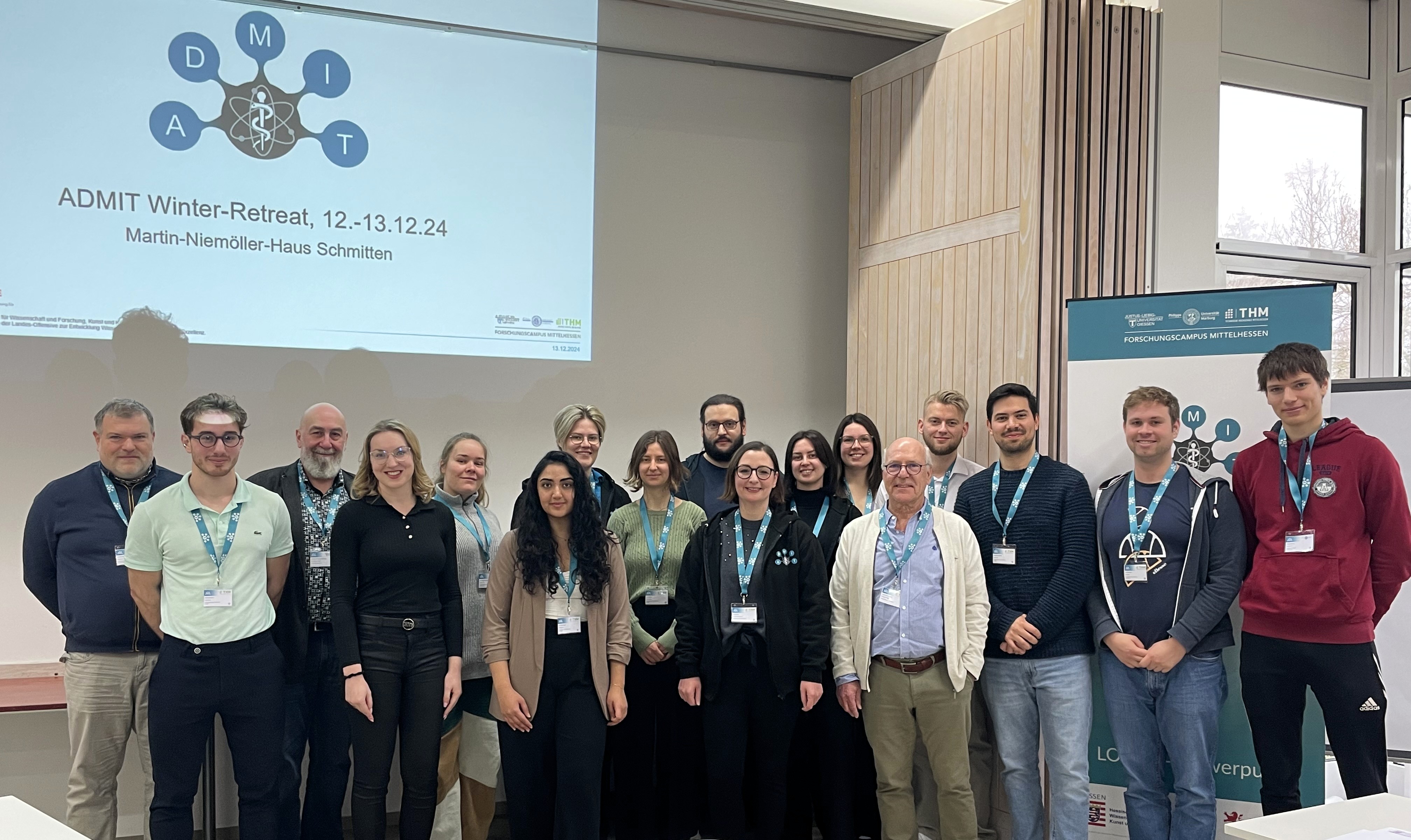
    Vom 12. bis 13. Dezember 2024 trafen sich die Mitglieder des LOEWE-Schwerpunkts ADMIT, in welchem die drei Hochschulen des Forschungscampus Mittelhessen (Justus-Liebig-Universität Giessen, Philipps-Universität Marburg, Technische Hochschule Mittelhessen) seit Jahresbeginn zusammenarbeiten, zum ersten gemeinsamen Retreat im Martin-Niemöller-Haus in Schmitten. Im Fokus standen die intensive...
  • Erste interdisziplinäre ADMIT Summer School für Medizinische Physik
    Lisa Kempus
    22.08.2025
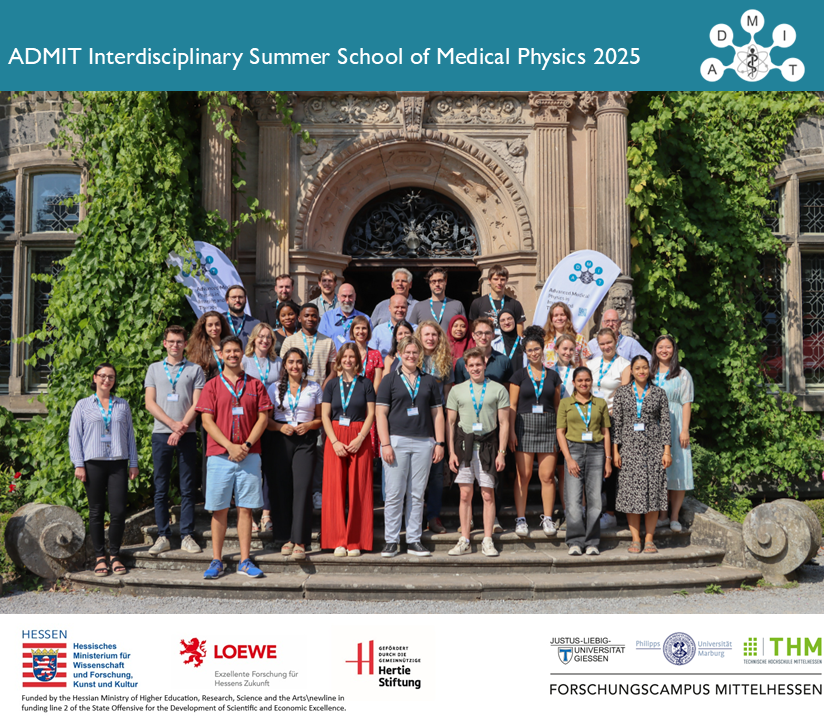
    Was für eine inspirierende und motivierte Gruppe! Vom 19. bis 22. August fand auf Schloss Rauischholzhausen unsere allererste ADMIT Interdisziplinäre Summer School für Medizinische Physik statt. Die Veranstaltung brachte rund 30 Nachwuchswissenschaftlerinnen und -wissenschaftler aus dem Bereich der Medizinischen Physik zusammen. Unser Ziel war es, umfassende Einblicke in verschiedene Fachgebiete zu...
  • Mit medizinischer Physik Krebs und Parkinson bekämpfen
    Pressestelle THM
    09.09.2024
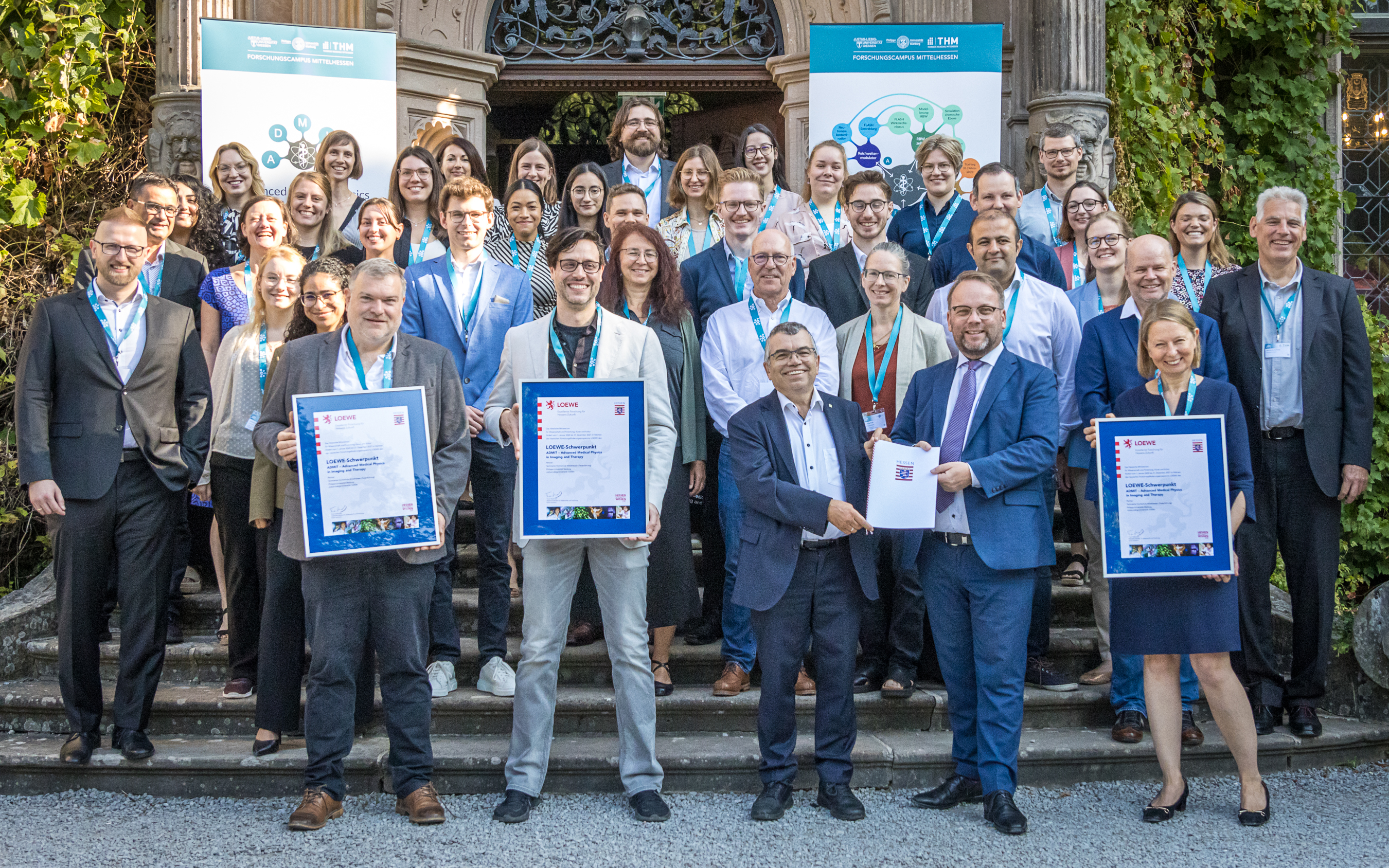
    Krebs und neurodegenerative Erkrankungen gehören zu den größten gesundheitlich-gesellschaftlichen Herausforderungen der heutigen Zeit. Unter Federführung der THM arbeiten die drei mittelhessischen Hochschulen seit Jahresbeginn im LOEWE-Schwerpunkt ADMIT (Advanced Medical Physics in Imaging and Therapy) gemeinsam an innovativen medizinphysikalischen Ansätzen, um diesen Herausforderungen zu begegnen....
  • Neue Wege gegen den Krebs
    Foto: THM/Björn Trebels
    Pressestelle THM
    04.07.2023
    Die Technische Hochschule Mittelhessen (THM) erhält eine Zuwendung in Höhe von 4,8 Millionen Euro zur Schaffung des LOEWE-Schwerpunktes ADMIT. Gemeinsam mit den Partnern Philipps-Universität Marburg  und Justus-Liebig-Universität Gießen (JLU) sowie weiteren Forschungseinrichtungen und Unternehmen aus Deutschland und den USA sollen neue bildgebende Verfahren für Diagnostik und Therapie von...