Monte Carlo simulation of beam quality correction factor kQ for carbon-ion beams using FLUKA and GATE for selected cylindrical and plane-parallel ionization chambers

Objective

To benchmark Monte Carlo codes FLUKA and GATE/Geant4 regarding the beam quality correction factors of ionization chambers for monoenergetic carbon-ion beams against experimental results by Holm et al (2022 Phys. Med. Biol. 67 49401).

Approach

Monte Carlo codes FLUKA and GATE/Geant4 were used to simulate the beam quality correction factor kQ for one plane-parallel (PTW 34001) and two cylindrical ionization chambers (PTW 30013 and IBA FC65-G) using two monoenergetic carbon-ion beams and an energy modulated beam in accordance with Holm et al (2022 Phys. Med. Biol. 67 49401). Additionally, chamber-specific factor fQ and perturbation factor pQ were calculated. Differences between Geant4 reference physics lists were investigated by comparing simulated depth dose distributions, fQ, and pQ values for 429 MeV u−1.

Main results

Simulated kQ factors were found to differ from experimentally determined kQ factors of Holm et al (2022 Phys. Med. Biol. 67 49401) by 2.5% for cylindrical chambers, whereas the plane-parallel chamber showed larger deviations of 3.1/2.6% (GATE/FLUKA), exceeding the simulation uncertainty of 1.7%. fQ and pQ factors simulated using different Geant4 physics lists were comparable within the Type-A uncertainty of 0.2%. Nevertheless, the depth dose curves for physics lists using the INCL++ model showed an increase in dose at all depths except for the fragmentation tail. Differences in fQ factors between Monte Carlo codes FLUKA and GATE of up to 1.8% have been observed.

Significance

More investigations are needed to understand the cause of the observed deviations between experimental results and Monte Carlo calculations of beam quality correction factor kQ. No statistically significant differences are observed between investigated Geant4 physics lists for fQ, kQ, and pQ simulations. Notably, differences between Monte Carlo codes FLUKA and GATE are one of the main sources that limit the current simulation uncertainty.

Aktuelles

  • ADMIT auf der ESTRO2025 in Wien
    Lisa Kempus
    06.05.2025
    Unsere Doktorandinnen und Doktoranden sowie Projektleiter (PI) Kilian Baumann aus dem ADMIT-Teilprojekt D nahmen an der ESTRO 2025 in Wien teil, die vom 2. bis 6. Mai stattfand. Die Konferenz bot ein breites Spektrum an Einblicken in aktuelle Entwicklungen der Radioonkologie. Besonders hervorzuheben waren die Beiträge zu den Themen biologische Modellierung und Partikeltherapie. Diese Themen sind...
  • ADMIT in Rom
    ADMIT
    24.01.2025
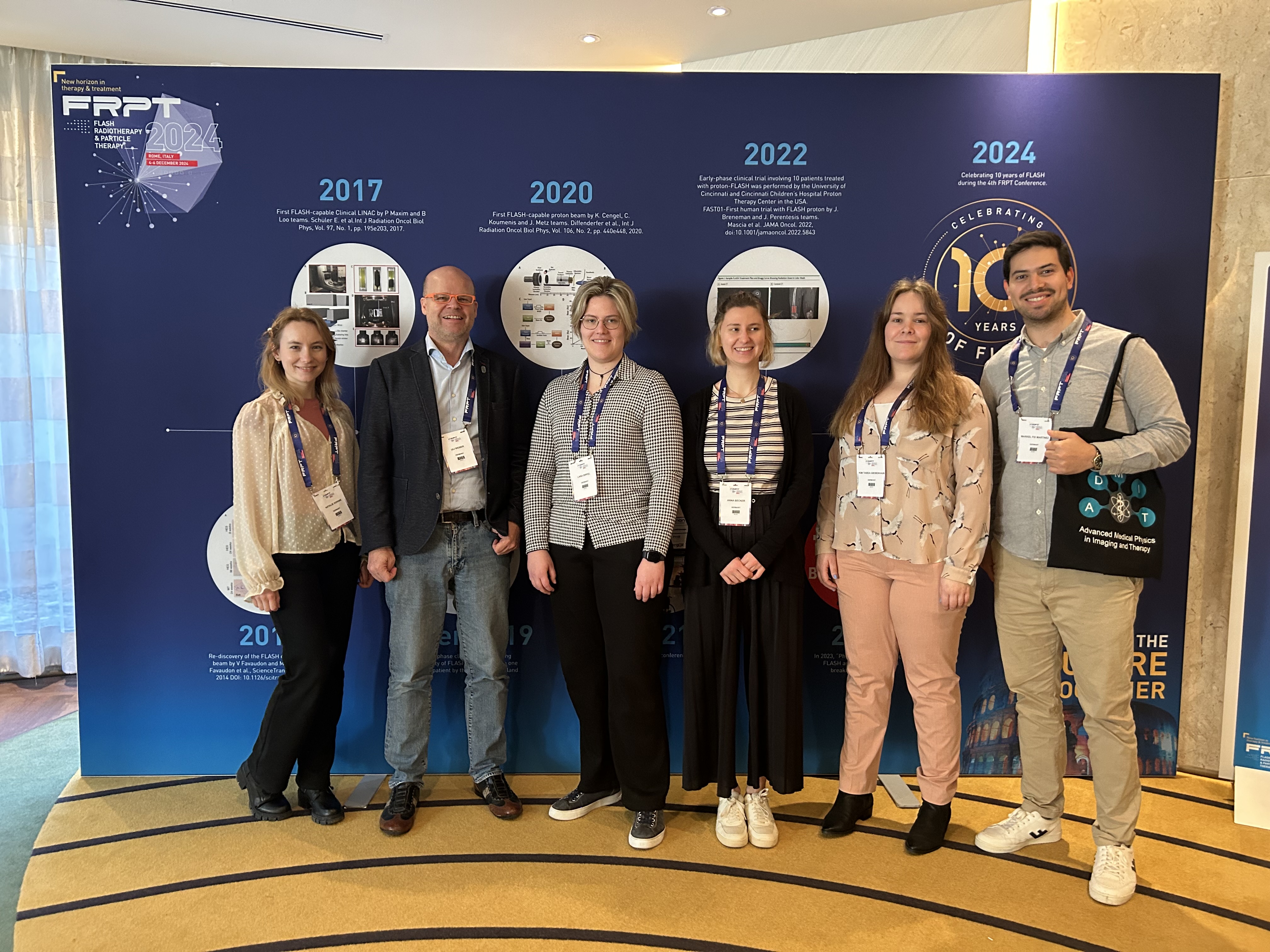
    Vom 4. bis 6. Dezember 2024 nahmen die ADMIT-Promovierenden der Teilprojekte A und D an der FLASH Radiotherapy & Particle Therapy - FRPT Konferenz 2024 in Rom, Italien teil.  In ihrer 4. Ausgabe fokussierte sich die FRPT2024 auf das vielfältige Themenspektrum der FLASH-Therapie. Diese neuartige Behandlungsmethode bestrahlt Tumore mit Photonen oder Partikeln mittels ultra-hohen Dosisraten. Dadurch wird...
  • Erfolgreicher Abschluss des 1. ADMIT-Retreats
    ADMIT
    24.01.2025
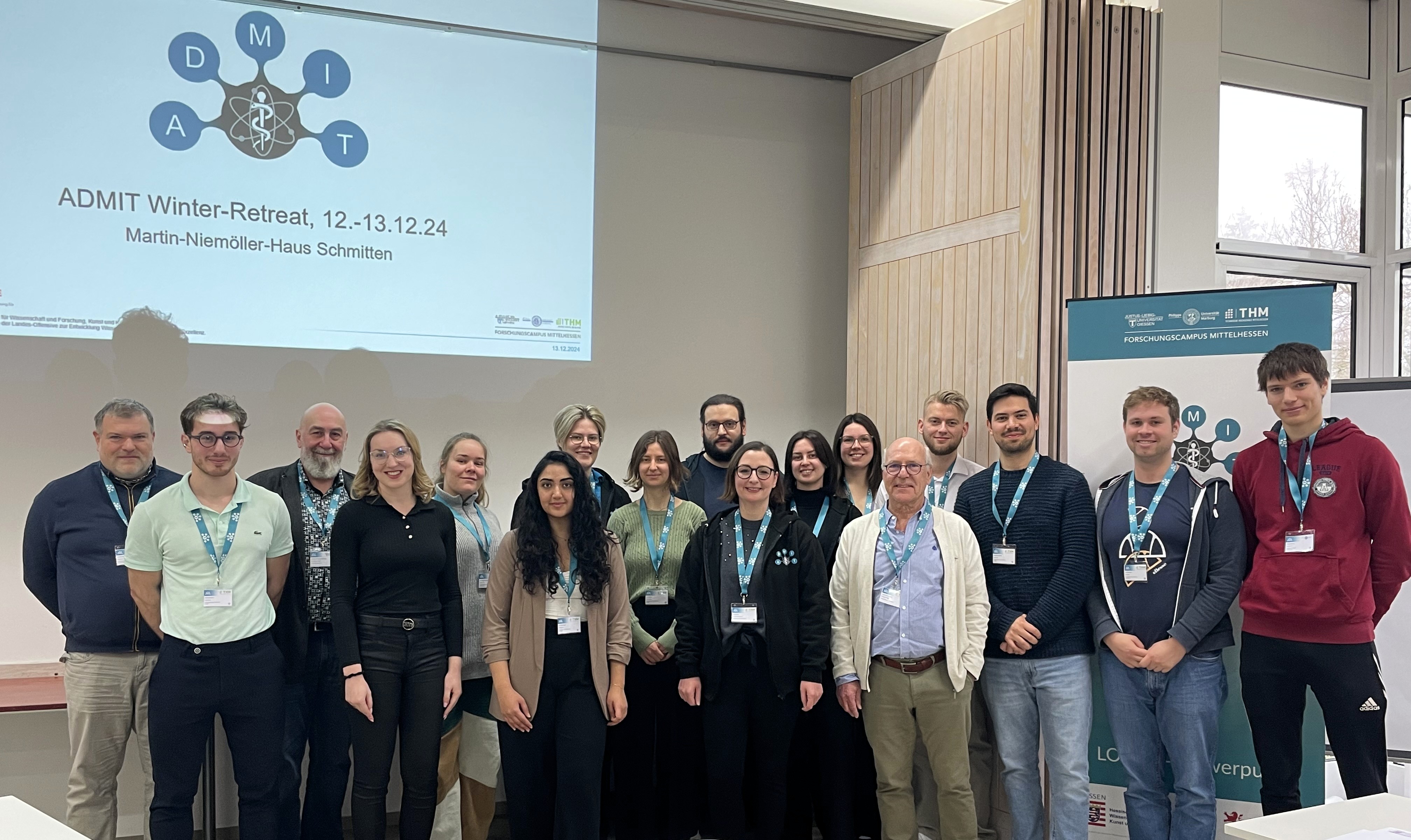
    Vom 12. bis 13. Dezember 2024 trafen sich die Mitglieder des LOEWE-Schwerpunkts ADMIT, in welchem die drei Hochschulen des Forschungscampus Mittelhessen (Justus-Liebig-Universität Giessen, Philipps-Universität Marburg, Technische Hochschule Mittelhessen) seit Jahresbeginn zusammenarbeiten, zum ersten gemeinsamen Retreat im Martin-Niemöller-Haus in Schmitten. Im Fokus standen die intensive...
  • Erste interdisziplinäre ADMIT Summer School für Medizinische Physik
    Lisa Kempus
    22.08.2025
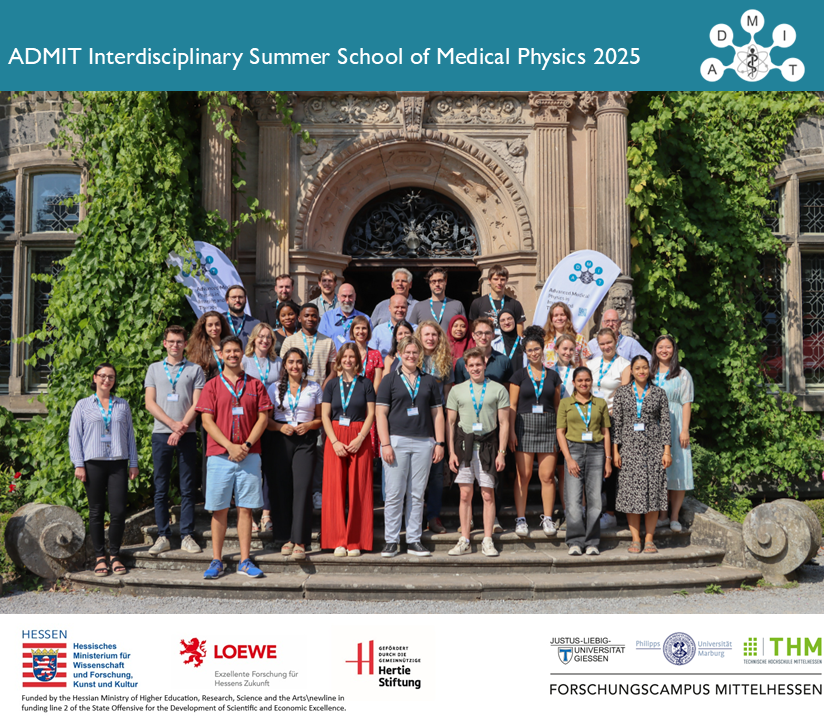
    Was für eine inspirierende und motivierte Gruppe! Vom 19. bis 22. August fand auf Schloss Rauischholzhausen unsere allererste ADMIT Interdisziplinäre Summer School für Medizinische Physik statt. Die Veranstaltung brachte rund 30 Nachwuchswissenschaftlerinnen und -wissenschaftler aus dem Bereich der Medizinischen Physik zusammen. Unser Ziel war es, umfassende Einblicke in verschiedene Fachgebiete zu...
  • Mit medizinischer Physik Krebs und Parkinson bekämpfen
    Pressestelle THM
    09.09.2024
    Krebs und neurodegenerative Erkrankungen gehören zu den größten gesundheitlich-gesellschaftlichen Herausforderungen der heutigen Zeit. Unter Federführung der THM arbeiten die drei mittelhessischen Hochschulen seit Jahresbeginn im LOEWE-Schwerpunkt ADMIT (Advanced Medical Physics in Imaging and Therapy) gemeinsam an innovativen medizinphysikalischen Ansätzen, um diesen Herausforderungen zu begegnen....

Forschende

Prof. Dr.
Kilian Baumann
Nachwuchsgruppenleiter
Dr.
Ulrike Theiß
Gruppenleiterin
Natalie Hornik
Doktorandin
Claudia Trier
Biologisch-Technische Assistentin
Yating Zhang
Postdoc

Publikationen

  • Analysis of hydrogen peroxide production in pure water: Ultrahigh versus conventional dose-rate irradiation and mechanistic insights
    Background Ultrahigh dose-rate radiation (UHDR) produces less hydrogenperoxide (H2 O2 ) in pure water, as suggested by some experimental studies, andis used as an argument for the validity of the theory that FLASH spares the normal tissue due to less reactive oxygen species (ROS) production. In contrast,most Monte Carlo simulation studies suggest the opposite. Purpose We aim to unveil the effect of UHDR...
  • Impact of dose rate and its definition on the production of hydrogen peroxide in pure water
    Introduction The clinical interest in particle therapy continues to grow due to its precise dose dis tribution and increased biological effectiveness. Recent attention has focused on ultra high dose rate (UHDR) irradiation, which has been associated with reduced normal tissue toxicity, an effect that is partially attributed to altered radiolysis chemistry. However, most existing experimental...
  • Investigating the impact of the effective point of measurement for plane-parallel ionization chambers in clinical proton beams
    Objective. To investigate the impact of the positioning of plane-parallel ionization chambers in proton beams on the calculation of the chamber-specific factor fQ and, hence, the beam quality correction factor . Approach. Monte Carlo simulations were performed to calculate the chamber-specific factor fQ in monoenergetic proton beams for six different plane-parallel ionization chambers while...
  • Monte Carlo simulation of beam quality correction factor kQ for carbon-ion beams using FLUKA and GATE for selected cylindrical and plane-parallel ionization chambers
    Objective To benchmark Monte Carlo codes FLUKA and GATE/Geant4 regarding the beam quality correction factors of ionization chambers for monoenergetic carbon-ion beams against experimental results by Holm et al (2022 Phys. Med. Biol. 67 49401). Approach Monte Carlo codes FLUKA and GATE/Geant4 were used to simulate the beam quality correction factor kQ for one plane-parallel (PTW 34001) and two...
  • On the Way to Accounting for Lung Modulation Effects in Particle Therapy of Lung Cancer Patients - A Review
    Particle therapy presents a promising alternative to conventional photon therapy for treating non-small cell lung cancer (NSCLC). However, the heterogeneous structure of lung tissue leads to the degradation of the Bragg peak and thereby to the degradation of the dose distribution. This review offers a comprehensive overview of the models developed to account for these modulation effects. It...